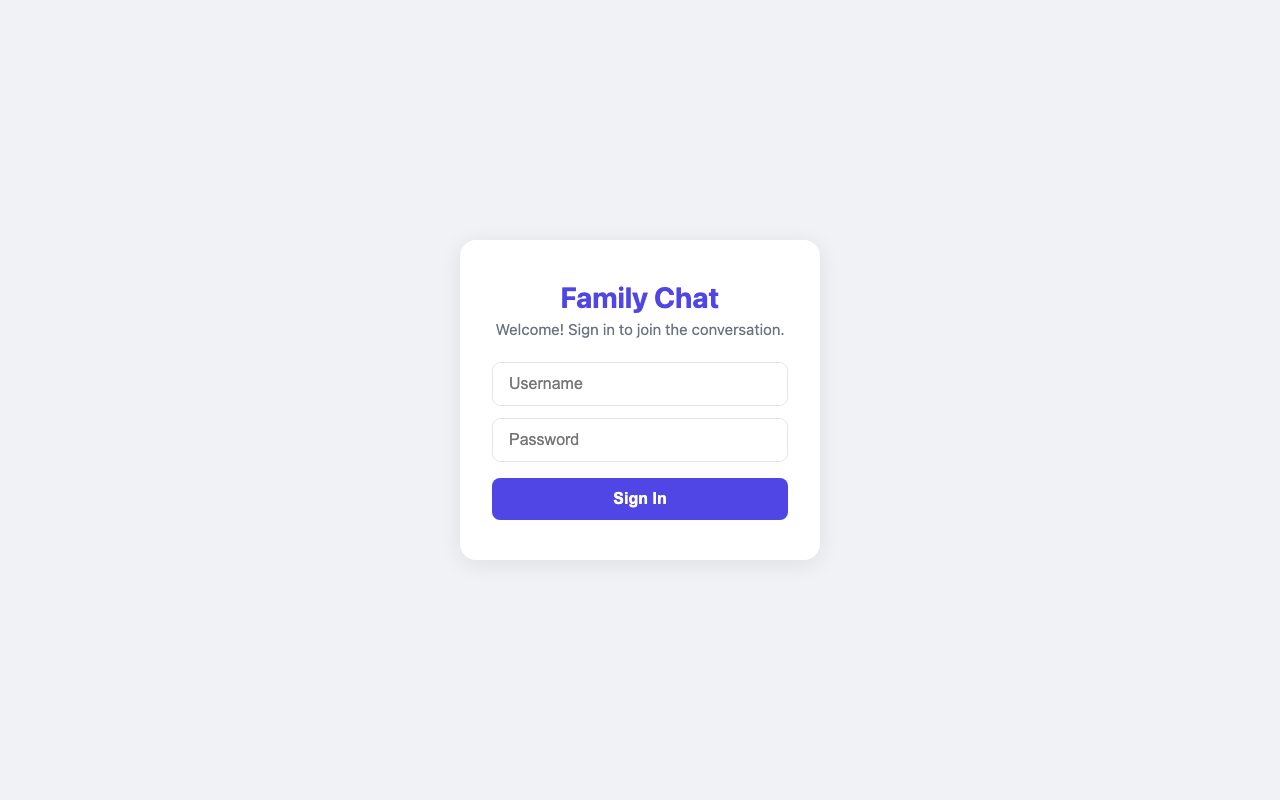
Family Chat
A private real-time chat — with self-hosted video calls
What it is
Family Chat is our own private messaging app — real-time text with reactions and presence, plus peer-to-peer video and voice calls — so the family has a space we control rather than a third-party service.
Architecture
A Node.js / Express server pairs with a React (Vite) client. The split is deliberate: REST handles authenticated operations (login, message history, uploads, admin), while Socket.io (WebSockets) carries everything live — new messages, typing indicators, reactions, presence, and the signaling for calls. History persists in MySQL.
Real-time design
- Reliable ordering & catch-up — messages are the source of truth in MySQL;
Socket.io events are optimistic updates. On reconnect the client requests
everything
afterits last seen message id, so nothing is missed during a drop. - Presence & typing — tracked in-memory per socket and broadcast live; typing indicators auto-expire so they never get stuck.
- Reactions — an atomic toggle backed by a
UNIQUE(message, user, emoji)constraint, so the database enforces one reaction per user per emoji.
Engineering highlights
- Self-hosted WebRTC calls — video/voice run peer-to-peer; the server only relays SDP offers/answers and ICE candidates over Socket.io and never touches the media stream (so it’s end-to-end encrypted by WebRTC default). No Twilio Video, Zoom, or per-minute cost — and a clean call state machine handles request / accept / decline / end and disconnect cleanup. Twilio is used for PSTN voice dialing where a real phone number is needed.
- Session invalidation done right — JWTs carry a
token_version; bumping it server-side instantly invalidates every outstanding token (a real “log out everywhere”), without a session table. - Version-aware client — the server broadcasts its running version and start time; the client prompts a refresh when it detects a redeploy, so nobody runs stale code against new APIs.
- Browser-based admin — family accounts, password resets, and ntfy push settings are managed from an in-app admin panel, all guarded server-side.
- Tested & mocked — server routes and the full WebRTC signaling flow are covered with Jest + supertest (DB mocked); client utilities with Vitest. Tests gate the deploy.
Infrastructure & delivery
The client builds into the server’s static dir; PM2 keeps the Node process
alive and restarts it on deploy. GitHub Actions runs both test suites, then
SSHes in to pull, build, run idempotent migrations, and pm2 restart. nginx
reverse-proxies with WebSocket upgrade headers; TLS via Let’s Encrypt.
What I learned
Real-time state is deceptively hard — presence, ordering, and reconnection took far more care than the initial happy-path chat. Building the video calls on raw WebRTC instead of a paid SDK was the most satisfying part: more work up front, but no vendor, no cost, and full control over the experience.